
|
Reader Resource
Try a Free Amazon Prime Account.
Many of the books and resources we recommend at Faithfully Magazine are available through Amazon. See if you're eligible for a free 30-day Prime account.
Affiliate link: Faithfully Magazine may earn a commission if you qualify and sign up, at no additional cost to you. Affiliate revenue helps support our mission.
|
Dear Reader,
I learned a long time ago, back in seminary, that the Gospel has to be contextualized for everyone — for every community.
We don’t all speak the same language. We don’t share the same cultures and traditions, or experience the same social and economic realities. I was assigned all kinds of books to read — books like Bruchko and I Heard the Owl Call My Name , as well as The Social World of Ancient Israel and Peoples of the New Testament World.
Why? Because the Gospel was revealed — and the Word became flesh — in a specific place and time, among particular communities of people. Ultimately, the Gospel is for all peoples everywhere.
So missiologists might ask: What does the Gospel look like among this people group? How is God revealed in this tribe's creation story? How might a White suburban mom come to see Jesus as a liberator?
The answers often come from listening to and empathizing with the people we hope to reach.
My mind was taken back to those books after reading this Associated Press article about a controversial sermon excerpt from Sarah Lucas, who co-pastors Foundations for Nations Church in Wyoming with her husband, Jason Lucas.
About five years ago, four years after founding the church, the Lucases built a $2.2 million building on the Wind River Reservation in Arapahoe, home to the Northern Arapaho and Eastern Shoshone Tribes.
The Lucases are not Native American, and they have apparently worn out their welcome on the reservation. After Pastor Sarah condemned the Arapaho sundance as "idol worship” in a July sermon, her church has faced protests. The Northern Arapaho and Eastern Shoshone tribal councils say they want her out — even though the church was built on private land.
Pastor Sarah insists she was simply preaching the Bible and exercising her First Amendment rights in that July sermon. But the AP reports that many Arapaho were stunned to hear an outsider disparage the ceremony and discuss details that aren't meant to be spoken of openly.
Even an Arapaho member of the church who agrees with Lucas that Native Christians should turn away from Indigenous ceremonies described the tone of the sermon as racist.
“She cares for our people,” Tearany Black told the AP. “I just don’t think
she understands where we’re coming from.”
And that’s the part that gets to me...
Click to read rest of this long commentary
Stay Faithful,
Nicola
Founder & Managing Editor
At 16th Street Baptist Church, memory becomes a public ministry
Sixty-three years after the Ku Klux Klan bombing that killed Addie Mae Collins, Denise McNair, Carole Robertson, and Cynthia Wesley, Birmingham’s 16th Street Baptist Church has opened a visitor center designed to carry the church’s history forward.
READ THE ARTICLEA 'third way' community tests the promises — and tensions — of radical discipleship
Reporters visit Followers of the Way, a Boston-area Anabaptist community of more than 100 people, many of them young immigrants and international students from Brazil and African countries. Members reject nationalism, consumerism, and electoral politics; practice pacifism and economic sharing; and have protested immigration raids. They also maintain conservative teachings on gender, dress, and church authority.
READ THE ARTICLEShould you have to pay to hear the Gospel?
For generations, the Black church has passed the offering plate to keep the lights on, pay the preacher, help the poor, and carry the Gospel beyond its walls. But what happens when the preacher leaves the sanctuary, takes a popular Christian podcast on tour — and charges admission? That question has placed Pastor Philip Anthony Mitchell at the center of a heated debate.
Rare Ethiopian manuscript stolen by British forces triggers restitution dispute
A sacred book looted by British forces from an Ethiopian king has prompted an intense ownership dispute after it resurfaced in a private sales catalogue nearly 160 years after it was stolen. The Gondarine Gospel, an ancient Bible originally in the possession of Emperor Tewodros II, was listed among rare books meant to be sold at the ongoing Abu Dhabi International Book Fair.
Leveraging Hospitality for the Gospel (Sept. 22 | 1PM ET)
The North American Mission Board is offering a free webinar for women on hospitality as a form of evangelism — using ordinary tables, homes and routines to build relationships and create space for spiritual conversations.
Register →Native Civic Power Series: Sovereignty at the Ballot Box (Sept. 22 | 2PM ET)
Hosted by the National Congress of American Indians (NCAI), this webinar explores current issues affecting Native civic engagement and efforts to strengthen Native voting rights.
Join the Webinar →Land Back as Property Stewardship Ethic (Sept. 24 | 7PM EST)
Indigenous leaders and ELCA partners will discuss the
Land Back movement, the Doctrine of Discovery, and church property, including congregations and synods already involved in land return and reconciliation.
Faith Under the Lash: Caribbean Enslaved Narratives, Power and Resistance (Sept. 27 | 11AM ET)
This free webinar hosted by the UK's Black History Studies examines how enslaved Africans in the Caribbean used religion as a profound tool for resistance, even as enslavers weaponized Christianity to justify oppression and maintain control.
Sign Up →Violent Action Thriller Is Really About 'Faith and Family...'

That's how John Cho describes his new film, “Your Mother Your Mother Your Mother,” in a recent interview. The trailer looks like pure action, but the premise is more layered. Actor Mahershala Ali (whose prep for the axed “Blade” movie likely came in handy here) stars as a contract killer and devout Muslim raising his kids after his wife's death.
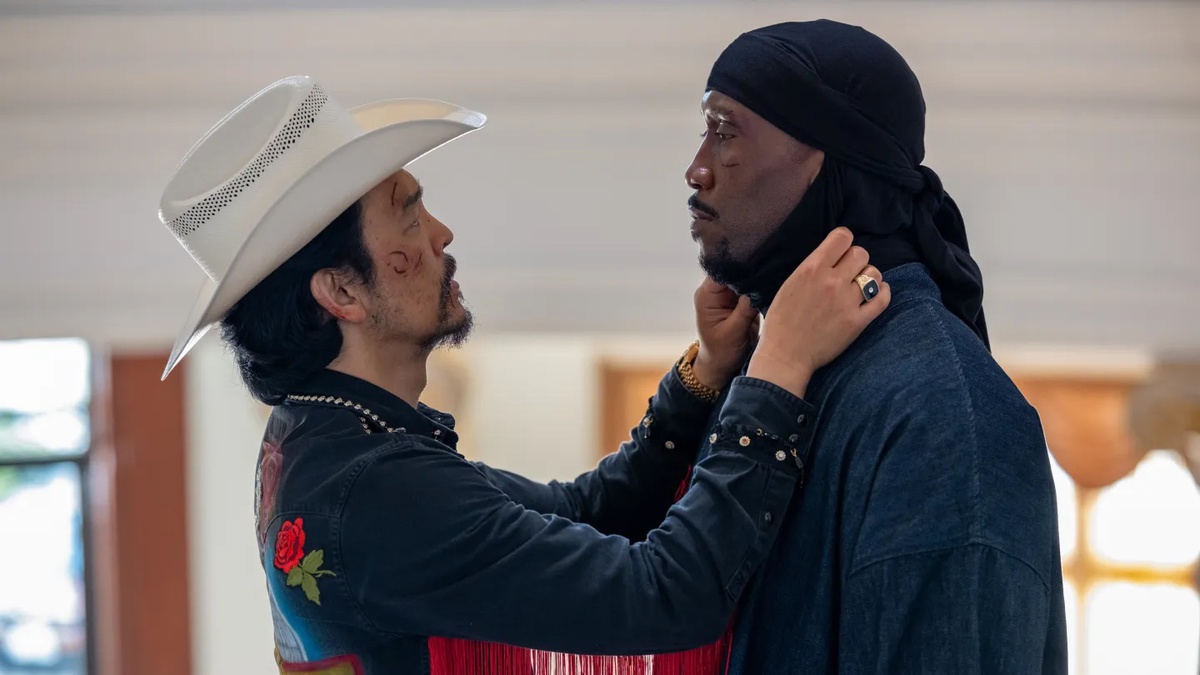
John Cho and Mahershala Ali in "Your Mother Your Mother Your Mother." (Photo: Amazon/Jaclyn Martinez)
Cho plays Ali's nemesis, Pastor Hwan Yoon. The Hollywood Reporter describes him as an Army veteran who started a "militant Christian church" after a near-death experience, one that uses violence to rid its community of perceived evils. Director Bassam Tariq wanted Yoon to represent a "colonized Asian" with identity issues, so the pastor embraces cowboy culture, Confederate imagery, and hip-hop-friendly custom grills (which Cho says helped him embrace the "discomfort" of the role). One reviewer called his character "a kind of line-dancing Asian David Duke."
Some of it is true to life for Cho . His family emigrated from South Korea to Texas before settling in California, which led to various assimilation issues. And his North Korea-born father was a Church of Christ minister, a detail Cho revealed years ago while appearing in “The Exorcist” series.
It will be interesting to see how a preacher's kid, raised in a strict worship envioronment, plays an unhinged Christian nationalist pastor — one who frankly reminds us of cultist Sean Moon (Hyung Jin Moon), leader of Moonie offshoot Sanctuary Church and its militant, far-right congregation.
“We knew these grants wouldn’t undo generations of discrimination, but we thought we could make a difference one family at a time.”
— Rebecca L. Grant on Quaker community's reparations efforts
Know someone who would value this issue? Forward it to them.